Why Companies Give Their Employees a Stake
Companies want their employees to pursue the same goals as their shareholders: a sustainable increase in corporate value. Startups and high-growth companies, in particular, also face competition from established employers, whose salary levels they often cannot match. A stake in the company’s future success offsets this disadvantage and turns employees into co-owners.
There are two basic approaches to this: rewards tied to company goals (bonuses) and instruments tied to the value of the company (employee stock ownership plans). Genuine employee stock ownership is considered the ideal solution: It preserves liquidity and offers the most attractive tax advantages. However, it is also the most complex instrument. Is it worth the effort? My answer, based on practical experience: That depends less on the company than on the employees.
An Overview of Three Instruments
- Bonus: A cash payment for achieving individual or company-wide goals, usually paid annually.
- Non-equity employee stock plans (phantom stock, stock appreciation rights): Employees do not receive shares, but rather a cash payment based on the value or appreciation of the shares. For startups, the payout is usually tied to a sale of the company (trade sale) or an initial public offering (IPO).
- True employee ownership (stock, options): Employees become shareholders—either directly or through options that they can later convert into stock at a predetermined price (exercise price).
Bonuses and Phantom Stock: Simple, but Fully Taxable
Under Swiss tax law, bonus payments and non-equity employee stock plans are treated the same: as wages, taxed at the time of payment.
For the company, the payment constitutes personnel expenses and is therefore deductible for income tax purposes, as are the employer’s social security contributions. The full amount is paid out: the payment plus employer contributions. In the case of phantom stock tied to an exit, the money is not paid out until the shares are sold. Economically, the shareholders bear the costs because the buyer deducts the obligation from the purchase price. Depending on the structure of the plan, provisions may also need to be set aside in the financial statements.
For employees, the entire payment constitutes income from employment. This is subject to income taxes and social security contributions: AHV/IV/EO at 10.6%, ALV at 2.2% up to a salary of CHF 148,200 (both split equally between the employer and the employee), and, depending on the plan, pension fund contributions as well. A tax-free capital gain is not possible. The advantage: Taxes are not due until money actually changes hands. Employees do not invest their own capital and do not pay taxes on income or assets they have not yet received.
True Participation: Two Key Dates Determine Tax Liability
With genuine employee stock plans, there are two points in time at which taxes may be due. I’ll explain them using the example of employee stock options, which are the most common instrument in practice.
1. Exercise of the Option
As long as an unlisted option remains unexercised, neither income tax nor capital gains tax is due. Upon exercise, the difference between the value of the stock and the exercise price is considered taxable earned income.
The value of a stock is defined as its fair market value —that is, the market price or the price paid in a recent, relevant transaction between independent third parties. If such a value is not available—which is typically the case for unlisted companies—a value calculated using a recognized valuation method is applied. I’ll explain how to determine this value correctly in a later post.
- Company: If the company issues new shares (e.g., from conditional capital or a capital range), this generally does not result in personnel expenses in the accounting records and therefore does not give rise to a tax deduction. However, employer contributions to social security are still due. Cash outflow occurs only for these contributions; the exercise price actually flows to the company.
- Employees: They pay income tax and employee contributions on income they did not receive in cash—so-called “dry income.”
Tip: Dry income can be reduced by imposing a lock-up period. If the shares are subject to a lock-up after exercise, their taxable value decreases by 6% per lock-up year, for a maximum of ten years. With a five-year lock-up period, only about 75% of the value remains taxable. However, if the lock-up is lifted early—for example, upon the sale of the company—the discount granted is taxed retroactively. More on valuation in a later post.
2. Sale of the Shares or Initial Public Offering (IPO)
- Market value upon exercise or sale after more than five years: The gain is generally a tax-exempt personal capital gain. Neither the company nor the employees owe any taxes or social security contributions. You should still review each individual case, however.
- Formula value and sale or initial public offering within five years: Only the increase in the formula value remains tax-free. The difference between the sale price and the formula value calculated at the time of sale is considered “excess profit” and is taxed as wages. In addition, social security contributions apply, as well as withholding tax for employees subject to withholding tax. I’ll explain exactly how this five-year period works in a later post.
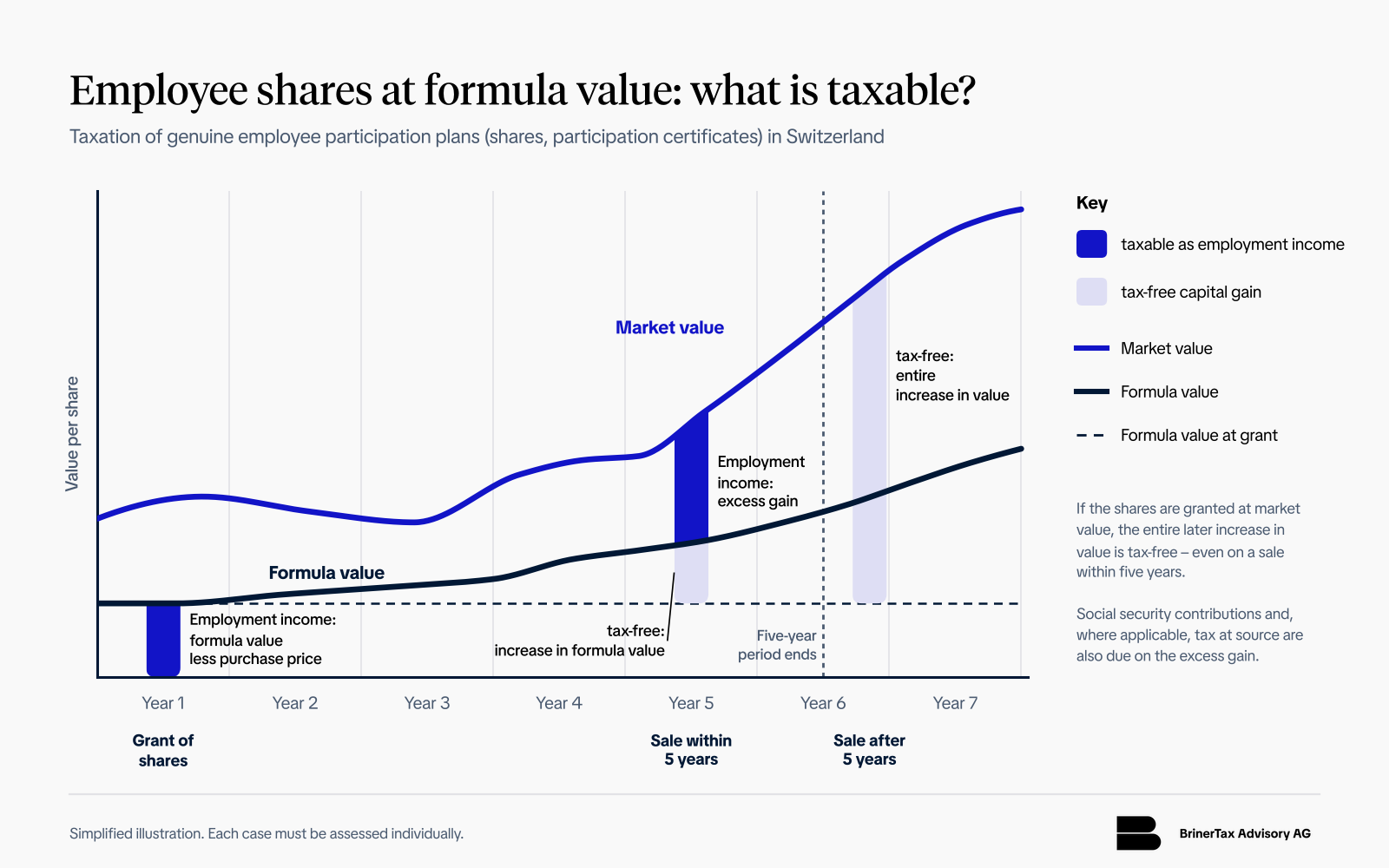
A Direct Comparison of the Three Instruments
| Bonus | Phantom Stock | Actual Equity Participation (Options/Shares) | |
|---|---|---|---|
| Taxation of Employees | upon payout | upon payout (usually upon exit) | Upon exercise or purchase; potentially capital gains upon sale |
| Tax-free capital gain | no | no | Yes (at fair market value or after five years) |
| Dry Income | no | no | yes |
| Corporate Liquidity | Payout plus employer contributions | Payout upon exit, borne economically by the shareholders | Only employer contributions; exercise price is included |
| Deductible expense (income tax) | yes | yes | Generally not applicable for new shares |
| Administration | Minimal | moderate | High, over many years |
| New shareholders | no | no | yes |
Why the Tax Advantage Often Fades Away in Practice
Anyone who exercises an option early pays taxes on dry income and assets, invests their own money, and bears the risk that the company will fail. A capital loss is not tax-deductible. In my practice, I therefore see the same pattern time and again: Employees wait to exercise their options until a sale or initial public offering (IPO) is on the horizon. But by then, the entire difference between the sale price and the exercise price is taxable income—just like with phantom stocks.
Here’s an example: An employee receives 1,000 options with an exercise price of CHF 1 per share (par value). Six years later, the company is sold for CHF 50 per share.
- Early exercise: She exercises the options at a formula value of CHF 5 and reports income of CHF 4,000 for tax purposes. Upon sale after six years, the remaining CHF 45,000 is a tax-free capital gain.
- Exercise only upon sale: She pays taxes on CHF 49,000 as wages.
At a marginal tax rate of 30%, the CHF 45,000 difference will quickly cost the employee over CHF 15,000 in social security contributions. And for the company, the situation is this: For employees who only exercise their options upon leaving the company, the company has borne the full cost of a genuine equity plan—without anyone benefiting from the tax advantage.
The Hidden Costs of Genuine Employee Stock Plans
Anyone introducing genuine employee stock ownership plans should also be aware of the costs that are often overlooked:
- Administration over many years: Every allocation, exercise, and sale must be tracked. The company must certify the shareholdings on the wage statement or in an attachment and provide copies of these certifications to the compensation fund. Everything must be fully documented by the time of the due diligence process prior to an exit, at the latest.
- Deferred Taxes—Even After Resignation: If excess profits are taxed, social security contributions are due on them, as well as withholding tax for employees subject to withholding tax. According to tax authorities’ practice, the company remains responsible for these payments even if the individual in question has long since left the company or is living abroad. The plan must therefore specify how the company will recover these funds—for example, by withholding a portion of the proceeds from the sale.
- Social Security: With regard to employee profit-sharing plans, social security regulations generally follow the rules of direct federal income tax. The guidelines issued by the Federal Social Insurance Office (WML) do not explicitly address whether and how the compensation fund also reports excess profits—please clarify this in advance. You should also check whether your pension fund’s regulations cover income from employee profit-sharing plans. Such income is often excluded.
- Leaver Provisions: If the company is required to repurchase shares from departing employees, this ties up liquidity. For employees, a tax-free capital gain is generally not recognized when the company repurchases their shares.
- Investors and Buyers: A large number of small shareholders can complicate subsequent financing rounds and sale negotiations. A shareholders’ agreement is therefore essential.
The Solution: The Right Tool for the Right Employees
A one-size-fits-all plan is rarely the best solution. A mix tailored to employees’ risk tolerance has proven effective:
| Target Audience | Appropriate instrument | Why |
|---|---|---|
| Founders, co-founders who join later (late founders) | Stock | Full ownership, opportunity for tax-free capital gains |
| Key personnel, executives, and board members willing to take risks | Stock options with the possibility of early exercise | Potential tax advantage; timing of taxation is up to you |
| Employees who do not want to or cannot invest their own capital | Phantom stocks, tied to the exit | No taxes on dry income; no liquidity until the exit |
| Short-term, measurable goals | Bonus | Simple and straightforward |
My most important tip: Ask your employees before you draw up the plan. Not everyone wants to become a shareholder—and a genuine equity plan whose tax benefits no one takes advantage of creates work without any return. Timing matters, too. If you set up a plan as early as the startup phase, you’ll tie up management resources that are needed elsewhere. However, the plan should be in place by the time the first investors come on board, at the latest. Otherwise, the values will rise—and with them, the taxes upon exercise—and the five-year period until the exit will become too tight.
Multiple instruments—multiple plans?
No. Options and phantom stock can be governed by a single equity plan with two modules: the same vesting rules, the same leaver clauses, and the same exit rules. The only difference is that some recipients receive shares upon exit, while others receive a cash payment. There is also hardly any additional effort involved in obtaining a tax ruling, since phantom stock does not raise any valuation issues—taxes are only assessed upon payout. The costs of a equity plan depend less on the number of instruments than on how many people actually become shareholders. A carefully chosen mix therefore tends to reduce ongoing administrative costs.
Conclusion: Is it worth the effort?
Yes—for employees who join early and share in the risk. Only through genuine employee stock ownership plans is a tax-free capital gain possible, and for the company, they are the form of ownership that puts the least strain on liquidity. For employees who would only exercise their options upon the company’s exit, however, phantom stock is the simpler and more cost-effective solution. The tax consequences are the same for them.
The key lies in the combination—ideally in a single set of rules: genuine equity for founders and key personnel, and phantom stock for everyone else. For unlisted companies, the best way to secure the chosen valuation method and the tax implications is through a tax ruling. This way, the company and its employees know exactly where they stand from the very beginning.
Structuring Employee Stock Ownership Plans in a Tax-Efficient Manner
I’ll assist you in selecting, planning, and implementing your employee stock ownership plan: from choosing the right instrument and determining the valuation approach to obtaining a tax ruling. In the process, I’ll also assess the implications for social security and ensure the plan is properly implemented in the contract—in collaboration with your attorneys or attorneys from my network.
Here’s how we get started:
Introductory consultation—free of charge, 15 to 30 minutes
You describe your situation to me, I assess it, and show you which issues need to be clarified. By phone or video call.
👉 Book an introductory consultation
After that, there are two options:
- Straight to the case: Once it’s clear what needs to be done, you’ll receive a quote and we’ll get started.
- Initial Consultation (CHF 250, credited toward a retainer): If your situation first requires an in-depth analysis, you’ll receive a written initial assessment to help you make a decision.
Are you a lawyer or trustee assisting a company with an equity plan? Give me a call directly—I’d be happy to discuss the case with you briefly.
Frequently Asked Questions
It is not required by law, but in practice it almost always makes sense for unlisted companies. With the ruling, the tax authority provides a binding confirmation of the valuation method and the tax implications. The ruling itself usually takes six to eight weeks; including preliminary discussions and follow-up inquiries, you should plan on about two and a half months.
Typically, these include a participation plan, an individual grant agreement, and—in the case of options—an exercise notice. If employees receive shares, a shareholders’ agreement is required, which, among other things, governs restrictions on sales and participation in an exit.
They specify what happens to equity interests when employees leave the company. “Good Leavers” (e.g., retirement, termination through no fault of their own) are usually allowed to keep their equity interests or receive a fair price; “Bad Leavers” (e.g., termination without notice) often have to return their equity at a low price. The definitions should be precise enough to hold up in court.
The company. It must calculate social security contributions and, for employees subject to withholding tax, withholding tax even on income that is realized only after the employee leaves the company—such as a capital gain upon exit. The equity plan should therefore specify how the company can collect or withhold these amounts.
When it is foreseeable that employees will not exercise their options until they leave the company, or when there is no realistic possibility of selling the shares at a later date. In these cases, companies bear the costs of a genuine plan without reaping the tax benefit—phantom stock or a bonus model is usually the better choice.
The company must disclose employee stock ownership in a statement accompanying the pay stub. For stock options and phantom stock, two statements are required: one at the time of grant and one at the time of exercise or payout. For shares, one certificate is generally sufficient upon issuance; additional certificates are required if a lock-up period ends early or if shares must be returned. If former employees realize a benefit only after leaving the company, the company must send the certificate directly to the tax authority of the canton where the employee resides.
Yes, right from the start—even with phantom stock, which also reduces shareholders’ proceeds at exit. As a general guideline, startups typically set aside a pool of about 10 to 15 percent of the capital for the exit; they start lower and gradually increase the amount. The exact size is a business decision that you should clarify with your investors and attorneys. From a tax perspective, it’s important that the shares are available in a timely manner—for example, through a capital band or conditional capital—and that the valuation and tax implications are clarified before the first allocation.
Cross-border commuters are generally subject to withholding tax in Switzerland. The company must also withhold this tax on income from employee stock plans. The amount Switzerland is allowed to tax depends on the double taxation treaty with the country of residence; for cross-border commuters from Germany, for example, the Swiss withholding tax is capped at 4.5%. Cross-border commuters should consult a local tax advisor to clarify the tax implications in their country of residence.
Adrian Briner
Certified Tax Expert / Certified Public Accountant
Founder and Owner of Briner Tax Advisory AG
With over 15 years of experience in Swiss and international corporate tax law, Adrian Briner advises companies, entrepreneurs, and CFOs on complex tax issues—ranging from restructurings, financing, and employee stock plans to international tax rulings. He assists startups and SMEs in selecting and structuring employee equity plans—from stock option plans to phantom stock arrangements—and secures their tax implications through rulings from cantonal tax authorities.
His practice focuses on providing tax guidance to SMEs as well as life sciences and tech companies.
Our Commitment: practical solutions, documented legal certainty, and data protection “by design.” BrinerTax processes all client data exclusively in Switzerland, using end-to-end encryption and in compliance with the Swiss Data Protection Act (DSG) and the General Data Protection Regulation (GDPR).
Basel | Olten | Zurich 🌐 www.brinertax.ch