A takeover can retroactively turn the taxation of employee stock upside down—even if the transaction itself is tax-neutral. A case that a colleague recently submitted to me for review illustrates how quickly CHF 30,000 in taxable income can turn into CHF 400,000.
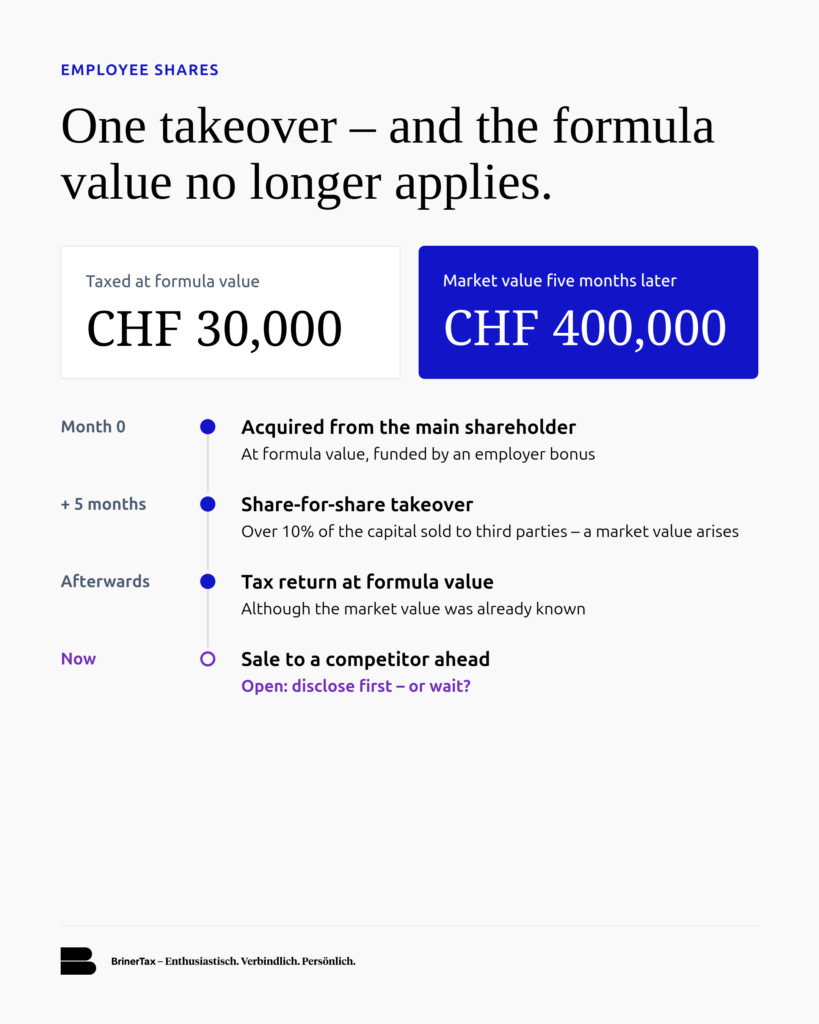
The case: CHF 30,000 taxed, worth CHF 400,000
- An employee purchased shares from her employer’s majority shareholder at a notional value of CHF 30,000. The employer financed the purchase price with a bonus of the same amount.
- The pay stub listed only the bonus. The shares were not listed—after all, they came from the shareholder, not from the company.
- The employer had obtained a ruling from the cantonal tax authority regarding the tax treatment of employee stock, its definition, and its reporting on the wage statement.
- About five months later, a competitor acquired the company. Shareholders had the option to sell their shares for cash or exchange them for shares of the acquiring company (quasi-merger). More than 10% of the capital was sold for cash.
- The employee exchanged her shares. At that time, her stock portfolio was worth CHF 400,000.
- She didn’t file her tax return until afterward—using the formula-based value, even though she already knew the market value.
- It now appears that the company is set to be sold to a competitor.
This raises two questions: At what value should the shares have been taxed at the time of acquisition? And what does the quasi-merger mean for the five-year period?
Formula Value or Fair Market Value?
If a price is available from independent third parties shortly after the acquisition, it supersedes the formula value. That is exactly what happened here.
For unlisted employee shares, the formula value—calculated using a recognized method—generally applies. Once a method is chosen, it must be retained for the equity plan. However, if a market value is available in exceptional cases, that value takes precedence.
Such a market value arises from a third-party transaction that meets two conditions:
- Timely: The transaction must occur within the period of six months prior to and six months following the acquisition of the employee shares.
- Significant: In accordance with Circular No. 28 of the Swiss Tax Conference (SSK), a transaction involving 10% or more of the equity is considered significant. Multiple smaller sales within this time frame are aggregated. If the prices vary, the lowest price generally applies.
The practice of the respective canton is binding in each individual case.
In this case, more than 10% of the capital was sold to an independent third party approximately five months after the acquisition. This established a market value. This would have made not only the CHF 30,000 bonus taxable, but also the difference between the fair market value and the purchase price of CHF 370,000—for a total of CHF 400,000. In any case, the exchange ratio of the quasi-merger alone would have established a fair market value.
There is one exception: If the employer has an unrestricted right to repurchase the shares at the formula value calculated in the same manner, the formula value may be retained upon request. Whether such a right to repurchase existed is one of the first questions to be addressed in any analysis.
Shares from a Shareholder—Still Considered Employee Shares
Who transfers the shares is not decisive for tax purposes. What matters is whether the acquisition is related to the employment relationship.
According to the case law of the Federal Supreme Court, even shares that a shareholder sells directly to employees are taxed as employee shares if there is a causal connection to the employee’s work.
In this case, everything points to a connection: The buyer was an employee, and the employer financed the purchase with a bonus. Because the employer made the transfer possible through the bonus and was aware of it, there is strong evidence that the employer should have certified the shares as an employee stock ownership plan. Especially in the case of a company that was aware of the tax administration’s practice through its ruling, the argument that “the shares didn’t come from us” does not hold up.
The five-year holding period: Does the quasi-merger interrupt the holding period?
It remains unclear whether the quasi-merger interrupts the holding period, and this must be clarified with the cantonal tax authority. No ruling regarding the quasi-merger was sought.
There are several factors at play in this case:
- From a tax perspective, a quasi-merger is considered an exchange—and therefore a disposition—for the shareholders.
- The employee could have sold her shares but opted for the exchange instead.
- At the same time, other shareholders sold their shares to an independent third party—a classic scenario for the transition to fair market value. However, according to the tax practices of certain cantons, sales by other shareholders to third parties—even if they are significant—do not interrupt the holding period.
The sale of employee shares from personal assets generally results in a tax-free capital gain. However, this applies only to the increase in value calculated using the same valuation method. Any additional gain resulting from a change from the formula value to the market value—known as “excess gain”—is taxed as income. It remains tax-free only if the triggering event (an initial public offering or sale to an independent third party) occurs after a period of five years.
The two questions are related: If the market value is taxed at the time of acquisition, no capital gain will arise later. If the formula value is used, the capital gain is likely to be recognized as a capital gain at the time of the quasi-merger—provided that the quasi-merger interrupts the holding period. If the formula value applies and the quasi-merger does not interrupt the holding period, the employee could still realize a tax-free capital gain—provided the sale takes place only after the five-year period has expired.
The Risks for Employees and Employers
It is not until the sale, at the latest, that the tax authorities first become aware of the high value. This also raises the question of how the shares should have been valued at the time of acquisition. If the tax authorities conclude that the shares should have been valued at fair market value at the time of transfer, this triggers a whole cascade of potential tax risks.
| Risk | Applies to | Possible Consequences |
|---|---|---|
| Additional tax and late-payment interest | female employee | Income tax on CHF 370,000, including late-payment interest |
| Tax evasion | female employee | Fines, generally equal to the amount of tax evaded |
| Participation in the tax evasion | Employer | Fines and joint and several liability for the evaded tax, including late-payment interest |
| Incomplete wage statement | Employer | The pay stub is a legal document—it could even raise suspicions of tax fraud |
| Social Security | Employer and Employee | AHV/IV/EO from 10.6% to CHF 370,000 plus late payment interest |
The allegation of tax evasion is based primarily on the timing: The employee filed her tax return after she was already aware of the market value. She should have at least disclosed the valuation issue. For the employer, the financing bonus and the existing ruling carry significant weight.
What’s still possible: Disclose the information before the sale
My recommendation: Disclose the facts before the sale. How this is done depends on the status of the 2024 tax assessment. It is no longer possible to obtain a ruling retroactively for the acquisition.
Tax assessment still pending: In this case, tax evasion has not yet been committed—it requires a final, incomplete tax assessment. The tax return will be corrected during the ongoing proceedings. Attempted tax evasion is a criminal offense only if committed with intent—which makes it all the more important to provide a complete and transparent account.
Once the tax assessment becomes final, the taxpayer may still file a voluntary disclosure without penalty. It is exempt from penalty only if it is the first such disclosure and the tax evasion has not yet come to the attention of any tax authority. In addition, the taxpayer must cooperate unreservedly in the determination of the back taxes and make a sincere effort to pay them.
Back taxes and late-payment interest remain due, but the fine is waived. The voluntary disclosure also covers any tax fraud. However, it is only exempt from penalties once; for each subsequent disclosure, the fine is reduced to one-fifth. And time is of the essence: the tax authorities will recognize the high value of the asset no later than the time of sale—after that, they may already be aware of the tax evasion.
The employer, too, can voluntarily disclose their involvement without penalty and thus avoid joint and several liability. A coordinated approach between the employee and the employer therefore makes sense.
Disclosure does not mean giving up every position. When disclosing information, the valuation issue can be made transparent, and one can continue to argue for the formula value—for example, if there was a right to purchase at the formula value. Only an in-depth analysis will show whether this holds up. The open question regarding the holding period can be clarified with the tax authorities at the same time.
Checklist for Companies
Any transaction with third parties can displace the formula value of existing employee shares. These points should therefore be included in any planning for an acquisition, financing round, or restructuring:
- Does the transaction result in a price agreed upon between independent third parties? If so: What payments to employees occurred within six months before or after the transaction?
- Have shareholders transferred shares to employees? For tax purposes, this may also constitute an employee stock ownership plan. If the company participates—for example, by financing the purchase—the transfer must be included in the certification accompanying the wage statement.
- Does the existing employee stock ownership ruling still cover the new structure?
- What does a stock swap mean for the employees’ five-year holding period?
- Apply jointly for a ruling on the transaction and its implications for employee share ownership.
- Inform employees in a timely manner—they are the ones who primarily bear the tax risk.
Conclusion
A tax-neutral restructuring does not automatically have no impact on employee stock. Addressing both the transaction and employee stock ownership together in a ruling creates clarity from the outset. After the fact, disclosure is often the only option left.
Regulating Employee Stock Ownership in a Tax-Efficient Manner During Acquisitions
Are you planning an acquisition, a financing round, or an initial public offering—and are employees involved? Or do you yourself hold employee stock and are unsure how it was valued? In a free introductory consultation lasting 15 to 30 minutes, we’ll clarify where you stand. Afterward, you’ll receive a quote.
👉 Book an introductory consultation
Are you a lawyer or trustee assisting a company with a takeover or an investment plan? Give me a call directly—I’d be happy to briefly discuss the case with you.
Frequently Asked Questions
If a material transaction between independent third parties takes place around the time of the acquisition—that is, within six months before or after it. In accordance with SSK Circular No. 28, this applies when the transaction involves 10% or more of the equity. The practice of the respective canton is binding.
Yes, if the purchase is related to the employment relationship. For tax purposes, it does not matter who transfers the shares. The employer must certify the transfer in any case if the employer is involved in the transfer—for example, by financing the purchase.
This issue has not been definitively resolved and depends on cantonal practice. Some cantons do not consider sales by other shareholders to third parties to be an interruption of the holding period. It is best to clarify this issue before the transaction through a tax ruling.
If it is the first instance, the tax authority is not yet aware of the tax evasion, the taxpayer cooperates fully, and makes a sincere effort to pay the back taxes. The fine is waived, but the back taxes and late-payment interest remain due. If the assessment is not yet final, the tax return is corrected in the ongoing proceedings instead.
Yes. As a participant in the tax evasion, the employer may, for the first time, report the offense voluntarily without facing criminal charges. This also eliminates joint and several liability for the evaded tax.
Adrian Briner
Certified Tax Expert / Certified Public Accountant
Founder and Owner of Briner Tax Advisory AG
With over 15 years of experience in Swiss and international corporate tax law, Adrian Briner advises companies, entrepreneurs, and CFOs on complex tax issues—ranging from restructurings, financing, and employee stock ownership plans to international tax rulings. He supports companies through acquisitions and restructurings, while also clarifying the implications for existing employee stock plans—backed by rulings from the cantonal tax authorities.
His practice focuses on providing tax advisory services to SMEs as well as life sciences and tech companies.
Our Commitment: practical solutions, documented legal certainty, and data protection “by design.” BrinerTax processes all client data exclusively in Switzerland, using end-to-end encryption and in compliance with the Swiss Data Protection Act (DSG) and the General Data Protection Regulation (GDPR).
Basel | Olten | Zurich 🌐 www.brinertax.ch