If you want to use German specialists for a Swiss group company, you need to examine the situation in detail: Tax law, social security and employment law all play a role – and the legal situation has changed fundamentally in the last two years.
Germany is Switzerland’s most important trading partner. Many Swiss holding companies have a subsidiary or sister company in Germany. The specialist staff on the German side are qualified and know the company. It is therefore obvious that the Swiss company wants to use the expertise of this staff for its own benefit.
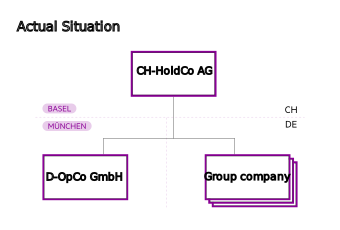
In practice, this is done in two ways: either via a service contract between the two companies, or via a local employment contract directly with the specialist. Both variants are permissible – and both have their strengths and weaknesses.
Caution: Staff leasing from abroad is prohibited
Before the tax question is even raised, an often underestimated risk lurks: the unauthorized hiring out of personnel from abroad to Switzerland.
The hiring out of personnel from abroad to Switzerland is generally prohibited – with a few exceptions, even within the Group. If you are not careful with the service contract, you run the risk of the Swiss company effectively becoming the employer – this already constitutes unauthorized staff leasing. This happens more quickly than you might think: if the right to issue instructions to the specialist based in Germany is transferred to the Swiss company or the specialist is integrated into its company organization.
The consequence: fines of up to CHF 100,000 and unexpected withholding tax consequences for the Swiss employer.
My recommendation: The service agreement must clearly state that the Swiss company has ordered a service from the German subsidiary and that this is not a loan of personnel. It helps to refrain from stipulating in the service agreement that the service must be provided by a specific person. The risk and responsibility for the service must also remain with the German company – including the right to issue instructions.
The complexity increases with the function
What applies in terms of tax and social security law depends to a large extent on what function the specialist performs and where they live and work. Two examples from practice:
Example 1 – The financial expert as a weekly commuter
A financial expert resident in Munich concludes a 50% employment contract with the Swiss holding company. He works two days a week in Basel, spends the night there and returns to Munich on Wednesdays. No home office. The financial expert continues to be subject to German social security law.
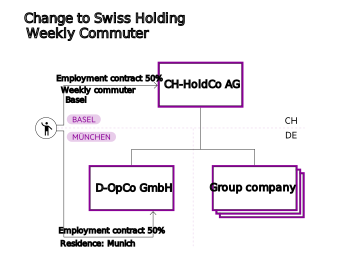
He qualifies as a weekly commuter. Switzerland taxes the salary attributable to the Swiss working days (withholding tax to be paid by the Swiss employer). Germany taxes the rest. Social security remains in Germany because he still works there 50% of the time. No permanent establishment risk for the holding company.
Manageable – but already associated with documentation requirements : Since January 1, 2026, actual working days must be certified in writing by the Swiss employer. The previous safe harbor rule of 240 working days no longer applies.
The Swiss holding company must also ensure that it reports and pays the German social security contributions correctly. It can either register itself as an employer in Germany or enter into a written agreement with the financial expert, whereby the latter registers with the social insurance institution and pays the contributions, with the employer contributions being reimbursed in each case. Regardless of the solution chosen, the Swiss holding company always remains liable for the payment of all social security contributions.
Example 2 – The CFO with authorized signatory
The same employee is promoted to CFO and entered in the Swiss commercial register as a director with collective signature. His workload at the holding company increases to 70% – and he now also works one day a week from his home office in Munich.
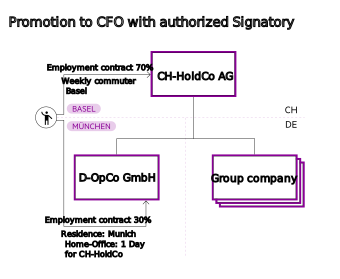
This fundamentally changes the tax situation: the CFO now qualifies as an executive employee within the meaning of the double taxation agreement (Art. 15 para. 4 DTA CH-DE). Switzerland taxes his entire holding company salary – including the home office day in Munich. Since January 1, 2025, Switzerland has had an explicit legal basis for this for the first time with Art. 5 para. 1 lit.abis DBG. This removes many years of legal uncertainty.
The CFO continues to work more than 25% effectively in Germany. As a result, the social security obligation remains entirely in Germany, which creates a permanent establishment risk for the holding company in Germany – at least under German unilateral law (so-called management permanent establishment). The practical countermeasure: Ensure and document that the CFO in the home office does not carry out any management activities (“day-to-day business”) of the Swiss holding company. In addition, authorized signatory should only be entered as a joint signature for two. This means that the CFO alone cannot enter into any legally binding obligations for the Swiss company, so that no contracts of the Swiss holding company with third parties can be concluded in Germany – the risk of a representative permanent establishment is significantly reduced.
What the latest legal changes mean
Four developments characterize the current legal situation:
The Federal Act on the Taxation of Telework (in force since January 1, 2025) creates for the first time a clear domestic basis for taxing executive employees domiciled abroad in Switzerland – even for working days performed abroad.
The revised DTA CH-DE (in force since January 1, 2026) clarifies the taxation of cross-border commuters and replaces the previous safe harbor rule with an obligation to document the actual days worked. In addition, provisions previously only regulated in consultation agreements – such as the division between Switzerland and Germany for severance payments to employees – have been raised to the level of an agreement and are therefore binding for the courts.
The OECD Model Commentary 2025 establishes the 50% threshold as the relevant criterion for a home office permanent establishment: Anyone who spends less than half of their working hours in their home office does not generally establish a permanent establishment under tax treaty law – nevertheless, the specific facts of the case must always be examined for management positions.
The draft of the BMF letter dated February 13, 2026 provides the first consolidated German administrative practice on the concept of a permanent establishment. It is still a draft – the final version remains to be seen. On the Swiss side, there is unfortunately no analogous specification of the concept of a permanent establishment for home offices of internationally active managers. In the reverse situation, i.e. Swiss specialists and a holding company in Germany, only obtaining a tax ruling will therefore continue to lead to legal certainty.
Conclusion
The “Swiss holding company with German specialist staff” constellation is commonplace. However, many companies underestimate the pitfalls of tax and social security law. As soon as the role of the specialist increases or home office comes into play, the analysis becomes complex. An early, holistic assessment – tax law, social security and employment law together – is not a luxury, but a necessity.
Together with my German colleague Tobias Stiegler (TAXGATE Partners, Munich), I have published a detailed specialist article on this subject in zsis), which outlines the principles of taxation and their implementation in practice and then applies them to six typical case constellations – from a simple service provider to a CEO with a home office in a border region.
👉 To the article on zsis.ch (accessible free of charge)
Making cross-border personnel planning tax-safe
Do you have specialist staff who work for a Swiss and a German group company at the same time? Then a structured analysis is worthwhile – before the next payroll or tax assessment raises the issue.
I examine existing and planned constellations for tax and social security risks and work with you to develop robust solutions. If necessary, I coordinate directly with my German colleague or your tax advisor in Germany.
👉 To the offers & packages: https://www.brinertax.ch/angebote
FAQ – German specialists in the Swiss holding company
In principle, yes – provided it is concluded at third-party prices and the German company retains the right to issue instructions to the specialist. It becomes critical if the specialist is de facto integrated into the business organization of the Swiss company.
The entry in the commercial register is decisive. Anyone who is registered with one of the functions listed in Art. 15 para. 4 DBA (director, managing director, authorized signatory) and signature authority qualifies per se as a managerial employee – without further circumstantial evidence. In all other cases, qualification as a managerial employee is not excluded, but must be specifically proven (corresponding authority and internal position).
Home office days in the country of residence do not count as non-return days according to the consultation agreement of July 15/18, 2022, which is still valid. They therefore do not jeopardize cross-border commuter status – as long as the 20% commuting threshold is met. For part-time employees who are only employed in the other country on a daily basis, the number of non-return days is reduced proportionally in relation to the number of working days.
As soon as the specialist works less than 25% of their total working hours in Germany, the social insurance obligation changes to Switzerland. Home office days in Germany count as working days in Germany. However, activities associated with the management of a company domiciled in Switzerland – namely board memberships – are never considered marginal, regardless of their scope. This means that a board member of a Swiss company domiciled in Germany is subject to Swiss social security contributions with his entire worldwide income if he is not at least 25% employed in Germany. Please note that a limited liability company of the board of directors usually does not help: Germany generally qualifies the management activities of sole or majority shareholders as self-employed.
Yes – especially in the event of changes in function or place of work. A ruling creates legal certainty for both parties and can be incorporated into the drafting of the contract.
About the Author
Adrian Briner
Certified Swiss Tax Expert / Certified Public Accountant
Founder and Owner of Briner Tax Advisory AG
Adrian Briner advises companies, CFOs and fiduciaries on complex tax issues – with a focus on Swiss-German cross-border constellations, corporate restructuring and international transfer pricing. He is co-author of the zsis article “Schweizer Holding und deutsches Fachpersonal: Steuern, Sozialversicherung und Betriebsstättenrisiko” (zsis) 2/2026, A5).
Basel | Olten 🌐 www.brinertax.ch