The term sheet has been signed, the loan agreement is with the lawyer – and the tax analysis has been postponed. This is a mistake that can backfire. If safe haven interest rates (see safe haven interest rates 2026) are not adhered to, the equity is too low or the 10/20 non-bank rule is overlooked, there is a risk of hidden profit distributions, withholding tax of 35% and, in the worst case, a set-off that makes the loan the most expensive capital the company has ever borrowed.
The initial situation is understandable: companies often cannot be financed exclusively through equity. However, bank loans are not always accessible to companies. Private investors are often more willing to take risks and finance the company by granting loans. However, tax implications must be taken into account.
Profit and income taxes
For the company that takes out a loan as a debtor, the interest expenses to be paid to the lenders are generally tax-deductible business expenses, which reduces the taxable net profit. However, this tax advantage can rarely be used by a company, as no profits are usually made and taxed in the start-up phase – the loan interest often only increases losses in the start-up phase. However, if the company generates profits in the following seven financial years, the losses can be offset against these profits and the tax burden is reduced accordingly. The loan itself generally qualifies as debt capital and thus reduces the company’s taxable equity.
Companies or natural persons as creditors who grant a loan must pay tax on the interest income as income. For them, the loan is a financial position which they must tax as assets or capital.
Financing by a related party
Permissible interest rates
If the loan is granted by persons related to the company, i.e. founders, shareholders or affiliated companies, the company must be able to prove that the agreed interest rate is in line with the market or can withstand a third-party comparison. Financing agreements concluded with banks or transfer pricing studies can be used for this purpose – bank offers that have not led to the conclusion of a contract are not sufficient. In Swiss domestic situations, the tax-recognized interest rates for advances or loans in Swiss francs or foreign currencies published annually by the Federal Tax Administration (FTA), the so-called safe-haven interest rates, can also be used as a basis (cf. Interest rates for withholding tax | ESTV). It is important to note that these safe-haven interest rates are only binding for the tax authorities in Switzerland.
According to a published leading decision of the Federal Supreme Court, the Swiss tax authorities are only bound by the minimum and maximum interest rates published by the FTA if a company itself adheres to these interest rates (9C_690/2022 dated July 17, 2024). If affiliated companies or persons do not adhere to the safe-haven interest rates, tax authorities may determine the amount of the interest rate in line with the market in another way, although the tax authorities must always provide evidence of the third-party comparison.
Interest rates not in line with market rates
If the safe-haven interest rates are not complied with or if proof of market conformity cannot be provided, the interest payment is partially or fully reclassified as a hidden profit distribution in the amount of the difference between the interest paid and the market interest rate.
Consequences for withholding tax
If an interest payment is fully or partially reclassified as a hidden profit distribution, it is treated as a dividend payment for tax purposes. This means that the payment is not tax-deductible for the company and is subject to 35% withholding tax (cf. CHF 339,500 withholding tax – although the dividend was never paid out). The company must pay the withholding tax to the FTA on the difference between the interest paid and the interest accepted for tax purposes and pass this on to the lenders. If it is not possible to pass this on to the creditors, the FTA assumes that the interest paid to the creditors was already paid after deduction of the withholding tax, i.e. net (65%). The interest actually paid is regarded as a net payment and added to the gross interest (100%) using the following formula:
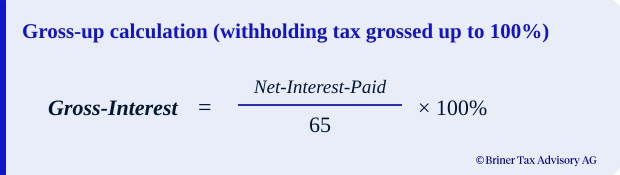
As a result, the withholding tax owed by the company increases to around 54% of the interest paid. It is therefore essential to avoid such offsetting into the hundred, as this increases borrowing costs enormously – which can quickly put a company in liquidity difficulties.
Legal entities and individuals domiciled in Switzerland can reclaim the withholding tax in full or have it credited against their taxes owed. Legal entities and individuals domiciled abroad can only reclaim the withholding tax in full or often only partially if Switzerland has concluded a double taxation agreement (DTA) with the respective country of domicile.
Consequences for profit and income tax
The shareholders of the company must pay income tax on a pro rata basis on a hidden profit distribution, similar to a dividend, even if the interest was not paid to them but to a related person or company (so-called triangular theory). If the shareholders have received the interest, the interest income is reclassified as investment income for tax purposes.
Hidden equity
When loans are granted by related companies or persons, it must also be checked whether an independent third party would grant the company a loan. In particular, the company must not be underfunded. To determine the necessary minimum equity capital, the Swiss tax authorities rely on the calculation methods set out by the FTA in its circular no. 6a.
If it is determined on the basis of these schematized calculation methods that the company does not have sufficient equity, part of the loan granted by related parties is reclassified as equity of the company (hidden equity). As a result, this part of the loan is not recognized as debt capital and interest on it is not deductible for tax purposes. The interest paid by the company but not recognized for tax purposes constitutes a hidden profit distribution, which triggers the aforementioned tax consequences. Companies are often tightly financed. It is therefore always necessary to check whether sufficient equity is available for the interest to be accepted for tax purposes. As the tax authorities calculate the amount of minimum capital schematically on the basis of book values, a calculation at market values can lead to higher equity. However, higher market values must be proven by the company.
10/20 non-bank rule
The interest from an individual loan is not subject to withholding tax – unless it is a concealed profit distribution as mentioned above.
However, this can change as soon as a company based in Switzerland concludes individual loans with several creditors and the so-called 10/20 non-bank rule is not complied with:
- The 10 non-bank rule states that a bond subject to withholding tax exists if a domestic debtor borrows money from more than ten creditors who are not banks in return for the issue of debt certificates on identical terms and conditions and the total loan amount is at least CHF 500,000. Financing can also subsequently become a bond subject to withholding tax, e.g. through assignment or syndication. A financing arrangement may also subsequently become a bond subject to withholding tax, for example, through assignment or syndication.
- The 20 non-bank rule states that a cash bond subject to withholding tax exists if a domestic debtor borrows money on variable terms from more than 20 creditors who are not banks in return for the issue of debt certificates and the total loan amount is at least CHF 500,000. Individual loans are also taken into account when calculating compliance with the 20 non-bank rule.
If the 10/20 non-bank rule is not complied with or if the number of non-bank creditors exceeds 10 or 20, this constitutes a bond or medium-term note for offsetting and stamp tax purposes:
- Turnover tax: Trading, but not the issue of the bond, is subject to a turnover tax of 0.15% on the selling price of the bond, provided that Swiss securities dealers are involved in the trading.
- Withholdingtax: More serious, however, is the fact that withholding tax of 35% is owed on the interest due on the bond. As shown, this can have negative tax consequences for creditors domiciled abroad.
Counting method: Non-Banks–creditor
In principle, each non-bank creditor is counted individually. However, if special forms of company such as partnerships or fiscally transparent entities are involved, the FTA can apply a “look-through approach”. This does not look at the company, but at the creditors behind it. However, if the lenders include funds, these are generally counted as a single non-bank creditor in accordance with FTA practice, unless they were set up specifically for a single financing arrangement. In order to create clarity in such cases, it is advisable to obtain a ruling on the counting method.
In addition, liabilities are segmented according to various categories: (i) over-year liabilities, (ii) under-year liabilities (money market paper), (iii) guarantee and security deposits and (iv) receivables without a fixed term and fixed amount (current account debt). Only if the number of non-bank creditors in one of these categories exceeds 10 or 20 is a bond or cash bond present. Group companies are excluded from the count.
Value added tax
Income from interest on borrowed capital is exempt from VAT. Creditors subject to VAT therefore often have to make a corresponding input tax adjustment.
Conclusion
Although debt financing is associated with costs, it offers the advantage that the equity ratio remains untouched and the shareholders retain control over the company.
Although the financing of companies in Switzerland by means of loans does not appear particularly complex at first glance from a tax perspective, a number of things need to be taken into account, particularly when loans are granted by shareholders or related parties and when loans are placed privately. To ensure that the Swiss tax authorities accept the loan as debt capital and the interest as tax-deductible interest, the FTA circulars on safe-haven interest rates and the circular on hidden equity provide good guidance.
As companies often attract investors from abroad and private placements of loans with several lenders are not uncommon, the structuring of loans and compliance with the 10/20 non-bank rule is particularly important here. For example, a bond issue can often be avoided by issuing another private placement with different conditions (term, interest rate, etc.). In addition, the loan agreement for private placements with domestic and, above all, foreign creditors must be carefully drafted. Specific clauses addressing the withholding tax risk must ensure that the 10/20 non-bank rule is complied with throughout the term of the loan.
For companies operating in a dynamic environment, expert advice is often essential in order to avoid tax pitfalls and structure contracts in a tax-optimized manner. By obtaining tax rulings on the valuation of equity, the method of counting loan creditors or the level of the permissible interest rate, companies and their shareholders can obtain certainty about taxation and avoid subsequent corrections by the Swiss tax authorities.
Securing your startup financing for tax purposes
Shareholder loans, private placements, 10/20 rule – the tax structuring of debt financing is complex and error-prone. I support start-ups and growth companies in drafting market-compliant loan agreements, thin-cap audits and obtaining binding tax rulings – before the tax authorities ask questions.
👉 To the offers & packages or book an introductory meeting directly.
FAQ – Financing start-ups & growth companies
In Switzerland, yes – as long as the published minimum and maximum rates are effectively adhered to. However, please note the Federal Supreme Court ruling 9C_690/2022 of July 17, 2024: The tax authorities are only bound by the safe haven rates if the company itself complies with them. In cross-border cases, you also need a third-party comparison (benchmarking/proof of refinancing) for foreign tax authorities.
If the thin-cap calculation in accordance with FTA circular no. 6a shows that the company is undercapitalized, parts of the shareholder loan are reclassified as equity. Interest on this part is not tax-deductible and can be qualified as a hidden profit distribution – including 35% withholding tax. Important: A calculation at market value can lead to higher recognized equity, but must be substantiated.
If you borrow money from more than 10 non-bank creditors on identical terms (≥ CHF 500,000), this is a bond for tax purposes. If you have more than 20 creditors with variable conditions, this is a medium-term note. Consequence: withholding tax of 35% on the interest – with negative consequences, especially for foreign creditors without DTA entitlement.
The following have proven their worth: an interest rate adjustment clause (annual adjustment to safe haven rates), reporting and documentation obligations as well as covenants to comply with the 10/20 rule – including the right to terminate if this is exceeded. In the case of complex structures, it is also advisable to obtain a tax ruling.
Whenever the safe-haven interest rates do not reflect the actual risk profile – for example in the case of subordinated loans, convertible bonds or foreign creditors. Clean transfer pricing documentation protects against double taxation risks and increases acceptance by foreign tax authorities.
About the Author
Adrian Briner
Certified Swiss Tax Expert / Certified Public Accountant
Founder and Owner of Briner Tax Advisory AG
With over 15 years of experience in Swiss and international corporate tax law, Adrian Briner advises companies, entrepreneurs and CFOs on complex tax issues – from restructurings, financing, tax due diligence in corporate transactions and employee participation plans to international tax rulings.
Claim: practical solutions, documented legal certainty and data protection by design. All client data is processed exclusively in Switzerland, end-to-end encrypted and in compliance with the GDPR.
Basel | Olten 🌐 www.brinertax.ch