Background: Why Private Investment Properties Have Been Attractive So Far
People who hold investment properties as part of their personal assets and receive the rental income personally often benefit from favorable tax treatment today. There is only one level of taxation: Net rental income is subject to income tax, eliminating the economic double taxation that would otherwise result from corporate income tax and income tax on dividends. For maintenance expenses, there is an option to choose between actual and flat-rate costs, and interest on debt is now largely deductible. When properties are sold, property gains tax is due to the canton, but no direct federal tax is levied (exception: if the sale qualifies as a commercial transaction).
This picture changes with the system change.
What Will Change as of January 1, 2029
On September 28, 2025, voters approved the reform of the taxation of home ownership. The Federal Council has set the effective date for the reform from April 1, 2026, to January 1, 2029 (see Federal Council press release). Until then, current law remains in effect. This means there will be a transition period until the end of 2028.
For owner-occupied residential property, the imputed rental value no longer applies; in return, most of the associated deductions are eliminated. Investment properties are not the primary target of the reform: Rental income remains taxable, and maintenance costs remain deductible. Nevertheless, they are affected by the legislative change in two respects.
Interest on debt is now subject only to proportional restrictions. In the future, interest on private debt will be deductible only in proportion to the ratio of real estate located in Switzerland that is not owner-occupied (i.e., properties that are rented or leased) to total worldwide assets (Art. 33, para. 1, lit. a nDBG). Important: The deduction is not property-specific. Anyone who does not own any rented properties can no longer deduct any private mortgage interest at all, and simply restructuring the mortgage will not help.
Example: the proportional-restrictive method
Rental property (Switzerland): CHF 4,000,000
Other assets (primarily securities): CHF 6,000,000
Total assets: CHF 10,000,000
Interest on debt (mortgage on the property): CHF 100,000
Ratio: 4,000,000 / 10,000,000 = 40%
Deductible: 40% of CHF 100,000 = CHF 40,000, even though the mortgage finances only the property. The remaining CHF 60,000 is not deductible.
The reason for the shortfall lies in the large securities position: Because the deduction is not property-specific, the remaining assets reduce the deductible amount. The reform therefore affects wealthy individuals with real estate and/or securities the most.
Maintenance, Energy Conservation, Demolition, Historic Preservation. For rental properties, the maintenance deduction remains in effect, whether calculated on an actual or flat-rate basis (Art. 32a nDBG). For owner-occupied properties, it is eliminated. For energy-saving and environmental protection measures, as well as demolition costs in connection with the construction of a replacement building, the deduction does not apply to direct federal tax; the cantons may maintain it on a temporary basis until 2050 (the canton of Aargau, for example, plans to do so). The deduction for historic preservation work remains in effect at the federal level; at the cantonal level, it depends on how the bill is implemented in each canton.
A side effect: For owner-occupied properties, the maintenance deduction also eliminates the time-consuming distinction between value-preserving and value-enhancing costs for income tax purposes. For real estate gains tax, however, this distinction remains relevant, and the taxpayer must provide documentation for value-enhancing investment costs. For rental properties, the distinction remains in place anyway, because only maintenance costs that preserve value are deductible. Value-enhancing expenses must therefore always be documented and, for taxpayers subject to accounting requirements, must be capitalized in the annual financial statements.
The following overview summarizes the key changes regarding the holding of real estate as part of one’s personal assets:
| Position | So far | Starting in 2029 |
|---|---|---|
| Imputed Rent (owner-occupied) | controllable | N/A |
| Maintenance of owner-occupied property | deductible (actual/flat-rate) | no deduction |
| Rented out for maintenance | removable | still deductible (actual/flat-rate) |
| Interest on Debt | largely deductible (general deduction) | Applies only on a pro rata basis to rental properties; first-time homebuyer deduction as an exception |
| Energy Conservation/Environment | removable | Federal government: no deduction; cantons: optional until 2050 |
| Demolition Costs (Replacement Construction) | removable | Federal government: no deduction; cantons: optional |
| Historic Preservation | removable | Federal level: still deductible; cantons: optional |
| First-Time Homebuyer Tax Credit | – | New: CHF 10,000 (married couples) or CHF 5,000, decreasing gradually over 10 years (Art. 33a nDBG) |
The key question: Should you hold properties privately or a through a corporation?
The restriction on interest deductions and the abolition – at least at federal level – of the deduction for the costs of energy-saving and environmental protection measures raise the question for owners of investment properties as to the optimal holding structure: whether to continue holding them as part of their private assets or within a company.
We are deliberately excluding here the case where the property is held as part of a natural person’s business assets (for example, as a professional real estate dealer). This option is often not freely selectable and is usually unattractive because, in addition to income tax, AHV/IV contributions of about 10% are levied on the profit.
Holding Assets in a Private Portfolio
For private assets, there remains a single level of taxation: Rental income is subject to income tax (federal and cantonal), and capital gains are generally subject to real estate gains tax (cantonal only). Maintenance expenses remain deductible, either on an actual or flat-rate basis. The flat-rate maintenance deduction is generally 10% of gross rental income for properties up to ten years old and 20% for older properties, or the actual costs, whichever is lower. Disadvantages include the interest deduction, which is now only allowed on a pro-rata basis, as well as the elimination of federal deductions for energy-saving and demolition costs (cantons may be exempt).
A significant risk. Anyone who sells real estate—especially if the purchases were financed with debt and involve frequent transactions—risks being classified as a commercial real estate dealer. In that case, in addition to taxation on the profit, AHV/IV contributions of approximately 10% are also due.
Holding Through a Real Estate Company
If a corporation holds real estate as part of its business assets, financing costs, actual maintenance costs, and depreciation on the real estate are fully deductible. Value-enhancing expenses (such as energy-saving measures) can or must be capitalized and can subsequently be depreciated to reduce tax liability. There are, however, no flat-rate allowances for maintenance; only actual maintenance costs are deductible (provisions for major repairs are no longer accepted by most cantons).
The trade-off is a second level of taxation: profits from rental income are subject to income tax (federal and cantonal) within the real estate company. Capital gains on real estate are subject to federal income tax and, depending on the cantonal system, either cantonal income tax or capital gains tax. If the profit is distributed to the individual, income tax is also levied on the investment income. However, if the individual holds at least a 10% stake in the real estate company, only 70% (federal) or 50–80% (cantonal) of this investment income is taxed.
The following example illustrates how significantly this can affect interest deductions and depreciation. For privately owned real estate, interest is deductible only on a pro-rata basis with restrictions, and energy-saving and environmental protection measures are not deductible at all. In a real estate company, however, interest expenses are fully deductible, and depreciation on capitalized energy-saving and environmental protection measures (as well as on other value-enhancing expenses) further reduces taxable income.
Example: Personal Assets vs. Real Estate Company
Same starting point as above (property worth CHF 4 million, other assets worth CHF 6 million, interest on debt of CHF 100,000). Additionally: a capitalized energy-efficiency renovation of CHF 500,000, depreciated at 2% per year based on the book value.
| Position | Personal Assets | Real Estate Company |
|---|---|---|
| Deductible Interest on Debt | CHF 40,000 (40%, pro rata-restrictive) | CHF 100,000 (full) |
| Depreciation for energy-efficiency renovation (2% of CHF 500’000) | CHF 0 | CHF 10,000 |
| Total tax-deductible amount per year | CHF 40,000 | CHF 110,000 |
This means that the real estate company can claim approximately CHF 70,000 more in tax deductions per year. (Depreciation rate according to FTA Information Sheet A/1995, “Business Operations”; assumption.)
This advantage alone does not tell the whole story. It must be weighed against the second level of taxation, transfer costs, and ongoing structural expenses. However, it does illustrate why it is worthwhile to conduct an analysis for larger, leveraged portfolios.
Plan Instead of Generalizing
Whether owning the property privately or through a company is the better solution depends on your individual real estate strategy, your financial situation, and your planned maintenance expenses. There is no one-size-fits-all answer; a detailed analysis is required.
If the analysis favors the corporation: the cost of the transfer
If the analysis concludes that the corporation is a sensible option, the type of transfer determines the tax consequences. A transfer from private assets to a corporation constitutes a change of ownership under civil law and generally triggers real estate gains tax and, if the canton imposes such a tax, transfer tax. There are two ways to do this, although the tax-neutral option is available only in specific cases.
Option A: Not tax-neutral; contribution at fair market value
Real estate is generally contributed at market value (some cantons allow contributions at book value). This immediately triggers real estate gains tax—up to 60% of the difference between the market value (or book value, if permitted) and the acquisition cost, depending on the holding period—and, if the canton levies it, transfer tax. If the real estate is contributed at market value, there is no tax-related holding period restriction on the properties. The transfer tax amounts to up to 3.3% of the property’s market value, depending on the canton—a significant amount for larger properties (some cantons no longer levy this tax). Despite these tax implications, this option is sometimes advantageous because capital gains tax is levied only at the cantonal level, and one benefits from low tax rates for long-term holdings (such as inherited properties). In addition, this creates the highest possible basis for depreciation (high property values), and no deferred taxes are recognized upon contribution. The trade-off: Taxes are due immediately, so liquidity is required. And be careful: The transfer must not be classified as commercial real estate trading; otherwise, direct federal tax on the profit and AHV/IV contributions of approximately 10% will be added.
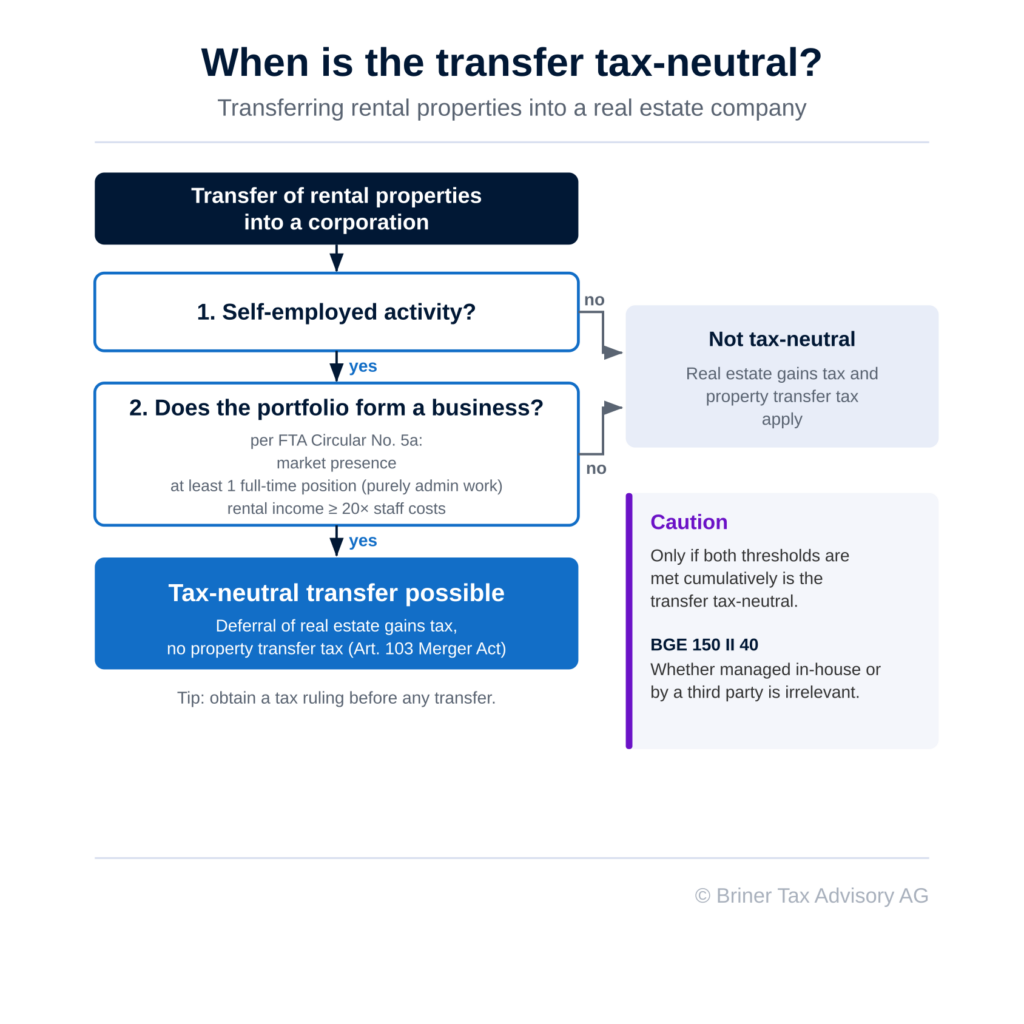
Option B: tax-neutral, but only for a “business”
A tax-neutral contribution (deferral of real estate gains tax under Art. 12(4) StHG, no transfer tax under Art. 103 FusG) is possible only if the real estate (i) was previously part of the natural person’s business assets and (ii) constitute a business (Art. 19(1)(b) DBG / Art. 8(3)(b) StHG).
The order is crucial: You must clear two hurdles in succession. First of all, there must be self-employment. In addition, this activity must constitute a business. Self-employment alone is not sufficient, because the definition of a business is narrower. For example, while a commercial real estate agent is self-employed, this does not in itself constitute a business.
Circular No. 5a, “Restructuring,” issued by the Federal Tax Administration (FTA), describes in section 3.2.2.3 when the second, higher threshold is reached. Professional real estate management requires the following cumulative conditions:
- Market presence;
- at least one full-time position for administrative or purely administrative work (either as a regular employee or on a contract basis); and
- Rental income of at least 20 times the market-rate personnel expenses; in practice, this means rental income in the range of CHF 2 million.
The Federal Supreme Court has upheld this practice and clarified that it does not matter whether the property is managed by the owner or by a third party acting on the owner’s behalf (BGE 150 II 40, affirmed in BGer 9C_87/2025). However, when assessing whether a self-employed business activity involving the operation of a business exists, the courts and cantonal tax authorities exercise great restraint, because the rental of one’s own real estate typically falls within the scope of the ordinary management of private fixed assets.
The Price of Neutrality: Assets are recorded at book value. This results in a lower basis for depreciation on the real estate and deferred taxes on the difference between market value and cost basis, which are taxed when the company (the federal government and the canton) subsequently sells the property and again when the proceeds are distributed (as a dividend) to the individual. In addition, a five-year holding period applies: If the equity interests are sold within five years at a price exceeding the tax basis, the hidden reserves will be subject to retroactive taxation (Art. 19(2) DBG). The period begins with the entry in the commercial register and passes to the heirs in the event of death—a key consideration in the context of succession.
Also note: Although gains from the sale of shares in corporations are generally tax-exempt, gains from the sale of shares in a real estate company by an individual are, in most cases, subject to real estate gains tax (key term: economic transfer of ownership).
Practical Tip: A real estate company is often worthwhile, especially when making a new purchase. Because the transfer of existing properties that have appreciated in value triggers capital gains taxes and property transfer taxes, entering the market with existing properties is expensive. Those who intend to acquire new properties anyway often purchase them directly through the company, thereby avoiding transfer taxes on the already accrued appreciation from the outset. For existing portfolios, however, the contribution must be carefully calculated.
Decision Matrix – Personal Assets vs. Real Estate Company, Effective January 1, 2029
| Criterion | Personal Assets | Society – Not Neutral (A) | Company – tax-neutral (B) |
|---|---|---|---|
| Interest on Debt | quota-restrictive | fully deductible | fully deductible |
| Maintenance | actual or flat-rate | actual (no flat rate) | actual (no flat rate) |
| Energy Conservation/Demolition | Federal: no (canton, possibly) | can be activated/removed | can be activated/removed |
| Depreciation | no | yes | yes |
| Tax Levels | one | two | two |
| Transmission costs | – | Immediate GGSt (+ transfer of ownership) | None (Deferral under Art. 12(4) StHG; Change of Ownership under Art. 103 FusG) |
| Depreciation base | – | high (market value) | low (book values) |
| Deferred Taxes in the Real Estate Company | – | deep | high |
| Lock-up Period | none | none | 5 years (Art. 19, para. 2, DBG) |
| Wealth Tax | Property at its assessed value | Shares at net asset value or earnings value; plus the company’s capital gains tax | Shares at net asset value or earnings value; plus the company’s capital gains tax |
| Succession/Divisibility | Real Estate, Individual Deed | Shares that can be easily split | Shares are easily divisible (note the lock-up period) |
| Structural costs | low | ongoing (accounting, possibly auditing) | ongoing (accounting, possibly auditing) |
| Risks of Commercial Trading | Yes (for sales) | Note the following when bringing in items | basically defused |
Procedure and Recommendation
The order is crucial. First, the strategy regarding the properties must be clarified (hold, develop, sell, bequeath), then the individual situation. Finally, the financing must also be clarified, particularly whether the bank is willing to finance the properties if they are held through a real estate company. Only then can the tax burden of the various scenarios be reliably calculated and weighed against the non-tax-related advantages and disadvantages. In any case, a binding advance ruling should always be obtained before transferring a real estate portfolio to a real estate company. This ensures that the transfer will not subsequently be (i) classified as commercial trading—resulting in additional direct federal tax and AHV/IV contributions—or (ii) have its tax neutrality contested because the requirements for self-employment or business status were not met.
The transition period through the end of 2028 is the planning window. It’s worth running the numbers now, rather than making a decision under time pressure in 2029.
How I Can Support You
I’ll guide you through the decision-making process in a structured way:
- Define Your Real Estate Strategy – What Do You Want to Achieve with These Properties?
- Assess your individual situation and goals —financing, maintenance, succession.
- Calculate the tax burden for the scenarios —private, non-neutral, and tax-neutral.
- Identify additional pros and cons —liability, wealth tax, succession, structure.
The result is a customized, transparent assessment of your scenarios at a fixed price agreed upon in advance. Predictable, reliable, and personalized.
👉 Optimize your real estate structure for tax efficiency: Schedule an introductory meeting today.
Frequently Asked Questions
The reform will take effect on January 1, 2029. Until the end of 2028, the current law will remain in effect, including the existing deductions for alimony and interest on debts.
Only on a pro-rata basis, based on the ratio of rented Swiss real estate to total assets. Those who do not own an investment property can no longer deduct interest on private debt (exception: the time-limited first-time homebuyer deduction).
Only if the properties constitute a business. For this to be the case, both self-employment and a business as defined in Circular No. 5a must be present. Otherwise, real estate gains tax and transfer tax are due.
This is often the case only with new purchases. For existing properties that have appreciated in value, the initial investment is expensive due to property gains tax and transfer tax and must be carefully calculated.
Yes. A binding preliminary ruling ensures that the transfer will not be classified as commercial trading and that its tax-neutral status will not be challenged retroactively.
Adrian Briner
Certified Swiss Tax Expert / Certified Public Accountant
Founder and Owner of BrinerTax Advisory AG
With over 15 years of experience in Swiss and international corporate tax law, Adrian Briner advises companies, entrepreneurs, and CFOs on complex tax issues—ranging from restructurings, financing, and employee stock ownership plans to international tax rulings. He brings particular expertise in the tax structuring of real estate portfolios, reorganizations, and succession planning—ranging from operational analysis and scenario planning to tax rulings.
His practice focuses on providing tax advisory services to SMEs as well as life sciences and tech companies. Our commitment: practical solutions, documented legal certainty, and data protection “by design.” BrinerTax processes all client data exclusively in Switzerland, using end-to-end encryption and in compliance with the Swiss Data Protection Act (DSG) and the General Data Protection Regulation (GDPR).
Basel | Olten 🌐 www.brinertax.ch