Anyone who buys a Swiss target company via a leveraged buyout often shifts the acquisition debt to the operating company via a merger – known as a debt push-down. In many cases, this is now a thing of the past. This article analyzes the ruling in detail, classifies it in terms of doctrine and practice and shows structuring alternatives for buyers of Swiss companies.
What was it about?
A. AG, domiciled in the canton of Geneva, owned a property in the canton of Geneva in which it operated a hotel. With a book value of CHF 1 million, this property was the main asset of A. AG. The shares in A. AG were held as private assets by a person domiciled in the Canton of Geneva.
In 2008, the previous shareholder sold his shareholding to C. AG for CHF 8.4 million. C. AG was a so-called acquisition company: it was founded shortly before the purchase by E. LLC, which was domiciled abroad. In order to finance the purchase of A. AG and to carry out the necessary renovations to the property, C. AG took out a loan from a bank in the equivalent of CHF 11 million shortly before the purchase. Shortly after the purchase, A. AG (target company) absorbed C. AG (acquisition company). The loan was thus transferred from the acquisition company to the operating target company.
What was the tax idea behind the merger?
The tax rationale behind this was clear: while the interest expense at the level of the acquisition company cannot be used for tax purposes – an acquisition company usually does not generate taxable income, but only tax-exempt income from dividend distributions of the target company thanks to the participation deduction – the interest expense at the level of the target company can be used to reduce the taxable profit from the operating business.
This practice is known as debt push-down and is common and accepted abroad. In Switzerland, however, it was already controversial before this ruling, as it means that the target company effectively finances its own acquisition. Until this ruling, however, the prevailing doctrine was that the tax authorities had to prove a tax avoidance in order to offset the interest deduction. The Federal Supreme Court has now taken a different approach: The interest deduction should not be allowed as a deduction because, in relation to A. AG, there was no business justification for the purchase price loan and the associated interest deduction (Art. 58 para. 1 lit. b DBG).
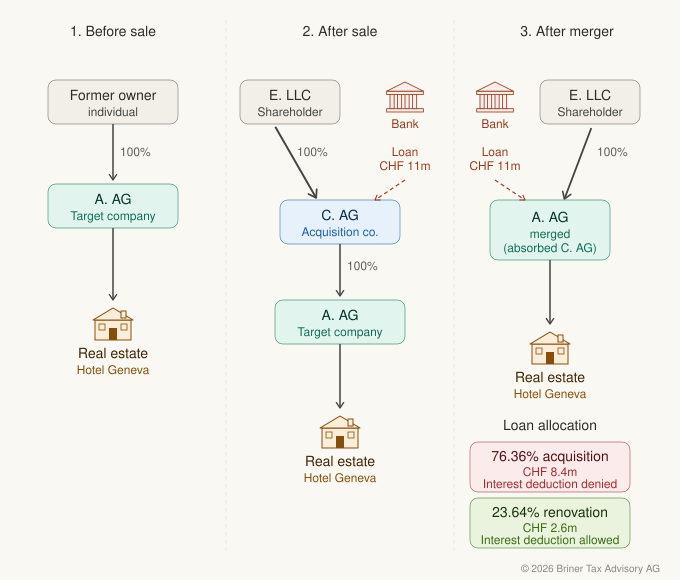
Figure: Debt push-down structure overview before and after the merger
Central considerations of the Federal Supreme Court
Periodicity principle beats total profit principle
In this ruling, the Federal Supreme Court once again categorically placed the periodicity principle before the total profit principle. According to the Federal Supreme Court, in view of its importance, the periodicity principle is preferable to the principle of taxation of total profit when implementing the principle of taxation according to economic performance (E. 7.4). According to this principle, the income and expenses specific to a certain period are to be allocated to it in order to determine the result that originates in this period (ibid.).
The Federal Supreme Court also emphasizes that the periodicity principle has a special significance in tax law and stipulates that a specific period must be allocated its own income and expenses (E. 9.1). Only if the consideration of previous tax periods is explicitly provided for in the law – such as in Art. 67 DBG, which allows the offsetting of losses from previous financial years against profits from the current financial year – should the total profit principle be observed. According to the Federal Supreme Court, such a relaxation is not provided for in Art. 58 para. 1 lit. b DBG, insofar as this provision relates to business-related expenses (E. 9.2).
No assistance from tax-neutral merger pursuant to Art. 61 DBG or universal succession
At the level of C. AG, the interest expense was undisputedly business-related – it served to finance the purchase of the participation in A. AG. In the present case, however, the BGer argued that the business-related justification of the interest deduction at C. AG did not predetermine that the interest deduction would remain business-related at A. AG even after the merger. This is despite the fact that the assets and liabilities of C. AG were transferred to A. AG by means of the merger as part of a universal succession. AG as a result of the merger, A. AG thus became the legal successor of C. AG and also assumed its obligations. According to the BGer, the business justification must be examined separately for each tax period – in this specific case, therefore, separately for the period before and for the period after the merger.
The actual economic activity after the merger is decisive – not the purpose of the articles of association
The business justification must be examined separately for each tax period – in the specific case before and after the merger (E. 9.1). As a tax-reducing fact, the taxpayer bears the burden of proof for the objective causal link between interest expenses and actual business activities. It is true that A. AG was authorized to carry out “all financial transactions” according to its articles of association, its main purpose remained the management of the property even after the merger. Therefore, the BGer only allowed the deduction of the part of the interest expense that was related to the renovation of the property (loan portion of CHF 2.6 million or 23.64%) – only this part served the actual business purpose. It did not allow the interest expense on the portion of the loan related to the financing of the purchase price (CHF 8.4 million or 76.36%) to be deducted because it was not business-related in relation to A. AG – although it confirmed that the same interest expense at the level of C. AG was indeed business-related.
Change of method? Tax avoidance was not examined by the BGer
The Federal Supreme Court already denies the debt push-down due to the lack of business justification for the interest expense at the level of the target company. This is an important change of method: previously, comparable cases often involved tax avoidance (with a high hurdle for the tax authorities). In particular, the Federal Supreme Court thus also contradicts the doctrine according to which an interest deduction is generally to be recognized in the case of a previous debt push-down and may only be offset in the case of tax avoidance (see box).
Conclusion
The result of the ruling is comprehensible: The acquisition portion of the loan (76.36%) did not finance a business-related investment by A. AG, but rather the purchase of A. AG by E. LLC – i.e. an expense that E. LLC would have to bear as a shareholder. I am convinced that the business justification must be assessed separately for each tax period and that only the facts of the respective period are decisive.
In my opinion, an additional examination of tax avoidance would nevertheless have been desirable – it would have given the decision a broader argumentative basis and clarified the relationship to previous case law. This ruling is likely to increase the risk of tax administrations offsetting interest expenses in debt push-down structures due to a lack of business justification – the high hurdle of tax avoidance no longer applies. How cantons that have previously permitted debt push-downs to a certain extent or after a blocking period will deal with this ruling will become clear in practice.
Take-aways for the practice
Check structuring alternatives
Debt push-downs no longer work for acquisition vehicles with weak substance and functionality. I recommend that buyers examine possible tax-efficient alternatives:
- Purchase of the target company via a parent company: The purchase of an investment by a parent company that generates its own taxable income continues to make sense from a tax perspective – the business justification at the level of the holding company was undisputed in this case. At the level of the parent company, the interest expense from the bank loan can be used to reduce the taxable income. Even after a subsequent merger of the parent company with the target company, the interest expense should be tax-deductible – provided it can be shown that the borrowed capital serves to finance the operating business of the merged company.
- Asset deal instead of share deal: The ruling of the Federal Supreme Court makes an asset deal even more attractive for buyers of shareholdings from a tax perspective. In an asset deal, the assets and liabilities of the target company are acquired at market value – plus any goodwill. The acquired assets and goodwill can then be depreciated at the level of the buyer company, thus reducing the taxable profit. As the operating income of the target company is at the same level as the debt financing in this structure, the interest payments also reduce the taxable profit.
Pricing in the impossibility of the debt push-down
I recommend that buyers take into account the risk of a debt push-down that is not accepted for tax purposes when purchasing via an acquisition holding company when calculating the purchase price.
Prioritize accrual accounting in the annual financial statements
The Federal Supreme Court confirms the primacy of the periodicity principle. I recommend that companies carefully review the timing of expenses and income for each financial year and – where permitted under Art. 960e para. 3 and 4 of the Swiss Code of Obligations (CO) – to generously defer liabilities in order to reduce the tax risk.
Documenting the allocation of the loan
In this case, the interest on the loan in connection with the renovation of the property was recognized for tax purposes. This was only possible because the taxpayer was able to explain the breakdown of the loan and its use. I therefore recommend that companies clearly document the use of borrowed funds.
Obtain a ruling in advance
In this case, a ruling was obtained in advance, but this only concerned the issue of indirect partial liquidation – i.e. securing a tax-free capital gain on the part of the seller. I recommend that buyers obtain a tax ruling in advance that covers all planned steps – this will not avoid tax consequences, but they can be included in the purchase price negotiations or taken into account in the structuring.
Making acquisition structures tax-safe
Have you acquired a Swiss company in a leveraged buyout with a subsequent merger in recent years? Then it is worth taking a look at your open assessments – the cantonal tax administrations will make use of this ruling.
I examine existing and planned acquisition structures for tax risks and work with you to develop options for action – before the issue arises in the next assessment. In the case of cross-border structures CH-DE, I also examine withholding tax and withholding tax aspects.
👉 To the offers & packages: https://www.brinertax.ch/angebote
Doctrine and criticism of the judgment
Contradiction to the prevailing doctrine
With its reasoning, the Federal Supreme Court contradicts in particular the doctrine according to which interest from the acquisition debt assumed by the target company should remain deductible even after the merger: What was business-related in the acquisition vehicle company should also remain business-related in the context of the new entity. According to this doctrine, interest on debt in a leveraged buyout with a subsequent debt push-down is only non-deductible if the transaction constitutes a tax avoidance. As acquisition financing with a leverage effect and subsequent transfer of the debt by means of a merger of the acquisition company with the target company is common practice internationally, according to this doctrine, tax avoidance is only present in very few cases.
This statement is essentially correct, but must be differentiated: The structure itself (leveraged buyout with subsequent up-stream merger) is actually standard international practice and therefore hardly qualifies as unusual in terms of tax avoidance. However, numerous jurisdictions have introduced specific defense rules in recent years that limit the amount of interest deduction after debt push-downs (BEPS Action 4, ATAD interest barrier in the EU, Section 4h EStG in Germany, IRC Section 163(j) in the USA). Even internationally, the unlimited deduction of interest after debt push-down is no longer a matter of course. The argumentation of the doctrine remains viable for the question of tax avoidance, but says nothing about quantitative admissibility.
Criticism of the strict priority of the periodicity principle
I do not agree with the strict priority that the Federal Supreme Court gives to the periodicity principle over the total profit principle – with a few exceptions provided for in the law. It is true that the Federal Supreme Court did not decide in this ruling what the situation is, for example, in the case of expenses that are booked outside the period but are business-related, which were (inadvertently) not claimed by the company in the previous period and only booked in the following period. However, it is clear from the BGE 137 II 353 cited in the ruling that the BGer also applies the strict line for expenses recognized outside the period – with the sole exception that the off-period recognition was within the scope of assessment under commercial law. However, this exception does not apply: if the accounting lies within the scope of assessment under commercial law, the expense is not aperiodic from a commercial law perspective anyway. If a company realizes that it has incorrectly booked an expense in the previous period, the only way to ensure that the expense is taken into account for tax purposes is to correct the balance sheet in accordance with commercial law (including approval by the Annual General Meeting).
Relevance of the new accounting law
In my opinion, the decision cited by the Federal Supreme Court, which is intended to demonstrate the primacy of the periodicity principle (BGE 137 II 353), is no longer readily applicable today. This decision was based on a case from 2002, i.e. under the old accounting law. However, the present case concerns a situation under the new accounting law, which came into force on January 1, 2013. The periodicity principle under tax law cited by the Federal Supreme Court is relativized in the corporate sector by that of accounting law (see Locher, Kommentar DBG, Art. 57 N 56 i.V.m. Art. 41 N 9). Errors in the previous year’s financial statements must be shown separately in the new financial statements in the income statement and corrected with corresponding explanations in the notes (Vangelis Kalaitzidakis, Periodische Besteuerung des Gewinns. Conflicts and ways out, Zurich/Basel/Geneva 2024 [= SStR 29], p. 316 f.). Expenses relating to other periods (Art. 959b para. 2 no. 9 CO) now form part of “an annual financial statement prepared correctly for this period as a whole” (Altorfer/Duss/Felber, Periodengerechte und periodenfremde Korrekturen, p. 733). In Swiss tax law, both the periodicity principle and the total profit principle apply alongside each other, and the prevailing doctrine is unanimous that the total profit principle should be given priority over the periodicity principle, provided that there is a corresponding scope for interpretation and application (Kalaitzidakis, loc. cit., p. 280). Only if the out-of-period correction is misused for an unlawful extension of the loss carryforward period or unlawful progression advantages are obtained, is a reduction in profit to be denied according to the doctrine (Locher, op. cit., Art. 57 N 56 in conjunction with Art. 41 N 12; Kalaitzidakis, op. cit. Art. 41 N 12; Kalaitzidakis, loc. cit., p. 327 f.).
Consequence for non-periodic expenses
In my opinion, aperiodic expenses should only be disallowed as a deduction if this would constitute tax avoidance.
FAQ on debt push-down
In a debt push-down, an acquisition company takes out a bank loan to purchase a target company. After the closing, the acquisition company and the target company merge – the debt is transferred to the operating target company, which can offset the interest expense against its operating income.
No. The BGer differentiates: The part of the loan that is related to the actual business activity of the target company (in this case renovations) remains deductible. The acquisition portion, on the other hand, is not business-related at the level of the target company.
In particular, the purchase via a parent company with its own income and the asset deal instead of the share deal remain tax-viable. In both variants, the interest expense can be offset against the operating profit without coming into conflict with the business justification.
The use of the bank loan should be documented in detail – per loan tranche and purpose. In this case, the taxpayer was able to do exactly this for the renovation portion, which is why this part of the interest expense was recognized.
Yes – but the ruling must cover all steps, not just partial issues such as indirect partial liquidation. A comprehensive ruling provides clarity on the tax consequences, which can then be incorporated into the purchase price negotiations.
About the Author
Adrian Briner
Certified Swiss Tax Expert / Certified Public Accountant
Founder and Owner of Briner Tax Advisory AG
With over 15 years of experience in Swiss and international corporate tax law, Adrian Briner advises companies, entrepreneurs and CFOs on complex tax issues – from restructurings, acquisition financing and leveraged buyout structures to international tax rulings.
Claim: practical solutions, documented legal certainty and data protection by design. All client data is processed exclusively in Switzerland, end-to-end encrypted and in compliance with the GDPR.
Basel | Olten 🌐 www.brinertax.ch