When I talk to business owners about their compensation strategy, the question almost always comes up in the same way: “How much should I pay myself as a salary, and how much as a dividend?” In the last two weeks alone, I’ve run scenario analyses on this for three business owners. The result was the same every time—and consistently surprising.
The first instinct: as much dividend as possible
This reaction is understandable. Qualified dividends from private assets are taxed only partially: 70% at the federal level, and between 50% and 80% at the cantonal and municipal levels, depending on the canton. And they are not subject to AHV contributions.
Salary, on the other hand, is 100% taxable, and social security contributions are also due. For a company in the Canton of Zurich, this amounts to approximately 14% in 2026 on salary components between CHF 90,720 and CHF 148,200—AHV/IV/EO 10.6%, ALV 2.2%, plus administrative costs and FAK totaling just over 1.3%, combining both the employer’s and employee’s shares. Above CHF 148,200, ALV is no longer applicable, leaving a rate of approximately 12%.
Even here, we see something that renders any rule of thumb useless: The load does not increase linearly. It jumps at defined thresholds.
But the real issue is something else. Once your relevant average annual income reaches CHF 90,720, you’ve reached the maximum AHV pension. Every franc above that amount no longer increases the pension. Contributions continue to be paid—but no longer result in benefits. Economically speaking, this is a tax, even if it isn’t called that.
For business owners, there is a second, often overlooked point: Those in employer-like positions are only entitled to unemployment benefits in exceptional cases—despite the recent adjustments approved by Parliament (see SDA report dated June 1, 2026). As a result, the 2.2% unemployment insurance contribution is often a levy with no corresponding benefit.
Conversely, the salary cannot be arbitrarily low. The compensation fund may reclassify part of the dividend as taxable income if the ratio is no longer appropriate. Two factors are decisive: Is the salary in line with industry and job standards? And is the dividend in reasonable proportion to the tax value of the equity interest? Anyone who focuses solely on optimizing the tax rate here runs the risk of having the amounts offset against each other.
What gets lost in the process: The wage is the ticket
This is the point that is regularly overlooked in the discussion. The most effective tax incentive requires a high salary—because only that creates significant buy-in capacity in the pension fund.
The purchase potential is determined by the pension gap as defined in the regulations, and this gap increases with the insured salary. A lower salary results in a smaller potential—regardless of how much money the company has on hand. The upper limit is set by Art. 79c of the BVG: the maximum insurable amount is CHF 907,200 per year.
There is also a separate instrument for the highest salary components. So-called 1e plans allow only salary portions exceeding one and a half times the upper BVG limit to be insured—which, in 2026, means amounts above CHF 136,080. Such executive plans allow insured individuals to choose their own investment strategy and create additional pension buy-in room in the non-mandatory sector. For entrepreneurs with high salaries, they are therefore often a more attractive supplement to the basic pension fund. The trade-off: Insured individuals bear the investment risk themselves, and upon withdrawal, the actual investment return is paid out—there is no minimum interest rate as in the mandatory sector.
The key point: The purchase does not have to be financed from one’s salary. The funds can just as easily come from a dividend. The salary merely creates the leeway—which can be filled with salary, dividends, or personal assets—depending on which option is most advantageous.
Why the effect is greater than most people expect
The scenarios revealed a twofold effect.
First, the purchase reduces taxable income—and does so at the highest tax bracket. The savings are therefore calculated not based on the average tax rate, but on the marginal tax rate. For a married couple in the canton of Zurich, whose average tax burden came to about 32% in my scenario calculations, the marginal tax rate was noticeably higher. That is precisely where every franc paid has an impact.
Second, the tax cut has the greatest impact where the tax rate is highest. Because the top income bracket is eliminated, the average tax burden for the entire year drops noticeably—in the example of the Zurich couple, from about 32% to a significantly lower figure. Added to this is an often-overlooked side effect: retirement savings are not subject to wealth tax.
These effects significantly exceed the 12 to 14% in non-pensionable social security contributions in the scenarios analyzed. And even when taking into account the subsequent taxation of the lump-sum withdrawal at the pension rate, there remained a considerable net savings.
A Comparison of Three Profit Distribution Options
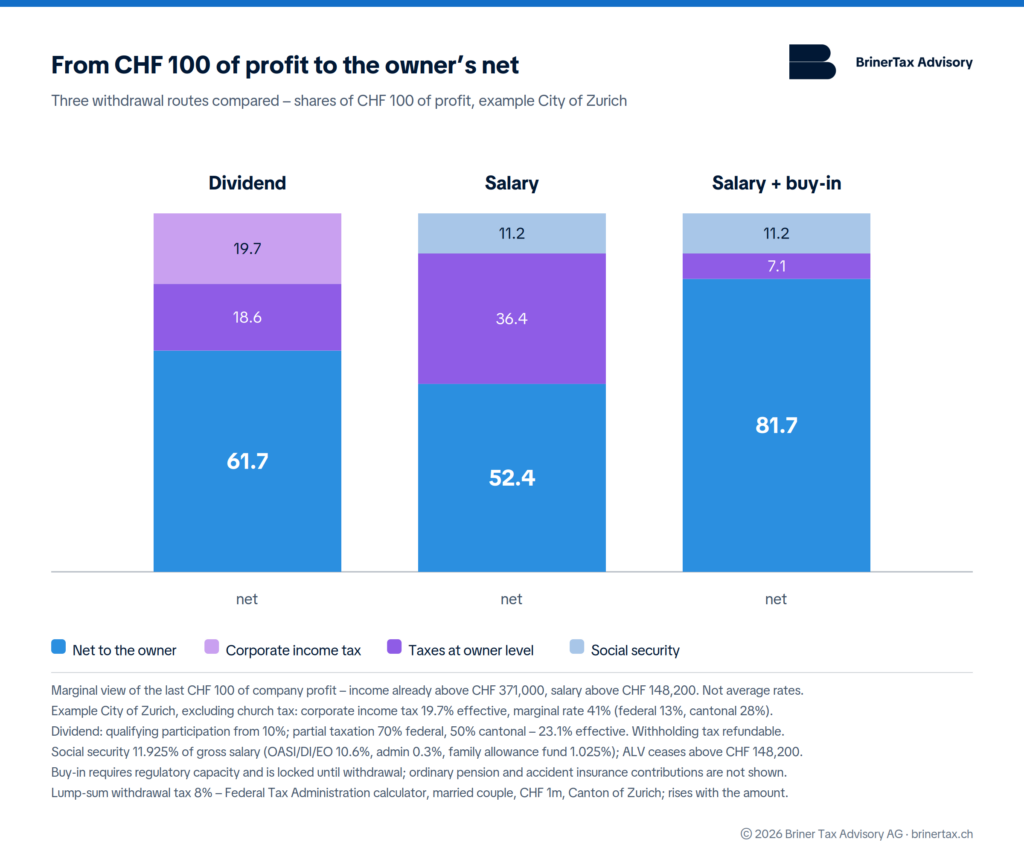
The graph shows the last CHF 100 in profit once the progressive tax scale has already been fully applied. It therefore cannot be extrapolated linearly: As soon as the buy-in pushes taxable income below the top tax bracket, each additional franc is taxed at a lower rate. How much a buy-in actually yields depends on the amount of income, not just the amount of the buy-in —and this can only be calculated on a case-by-case basis. Important to know: The “salary + pension fund buy-in” option is not an add-on to the first option. Without salary, there is no potential for buy-ins, and without that potential, this option is not available. That is precisely the point: The path to the best outcome involves an option that, at first glance, appears to be the most expensive.
Four Pitfalls That Can Undermine the Effect
Collectivity. The most common mistake is to tailor the pension plan to one’s own needs: a generous executive plan for the owner, while the rest of the workforce remains at the BVG minimum. That doesn’t work. Membership in an insured group must be based on objective criteria—function, hierarchical position, years of service, age, or salary level (Art. 1c(1) BVV 2). While insuring a single person is also permitted, this is only allowed if the plan regulations generally permit the inclusion of additional persons—the so-called “virtual collective” under Art. 1c(2) BVV 2. In addition, there are requirements regarding adequacy, equal treatment, systematic planning, and the insurance principle. From a tax perspective, this is no mere formality: if the plan does not meet these requirements, the pension fund will not receive tax recognition—and the buy-in deduction will not apply. The lock-in periods discussed in the next section will then no longer apply. The solution lies not in circumventing the rules, but in making use of them. A clearly defined group of executives with objective eligibility criteria is permissible and common—and in the non-mandatory sector, 1e plans offer highly attractive solutions for salary portions exceeding CHF 136,080.
The three-year period. After a purchase, the resulting funds may not be withdrawn as a lump sum for three years (Art. 79b, para. 3, BVG). Anyone who violates this period risks having the deduction offset—the savings will be collected retroactively. The cases discussed involved a lump-sum withdrawal upon normal retirement; however, the same logic applies equally to early retirement or an advance withdrawal for home ownership. Anyone wishing to make a buy-in shortly before the withdrawal must schedule the final buy-in accordingly.
The payment schedule. Lump-sum payments are taxed at the pension tax rate, which is also progressive. Multiple withdrawals in the same year are aggregated; for married couples, this may also include withdrawals by both spouses, depending on the canton. A single large withdrawal can erode a significant portion of the benefit gained from the purchase. How expensive the lump-sum withdrawal will be depends on the canton of residence at the time of the withdrawal—not on the canton of residence during the years in which the buy-ins were made. The cantons calculate this differently: Some cantons, like the federal government, apply one-fifth of the standard tax rate, while Zurich applies the rate that would apply to one-twentieth of the benefit as income, with a minimum of 2% (basic cantonal tax). It’s impossible to say in general terms which canton is more favorable—it depends on the amount of the withdrawal. For a married couple withdrawing CHF 1 million, for example, Zurich and Solothurn are practically tied at around 8%, Basel-Stadt is significantly higher at just under 10%, and other cantons are below that.
A look back at just one year. The dividend strategy is a multi-year consideration. Purchase potential, lock-up periods, distributable profits, and the planned dividend payment date are all interrelated. Those who focus solely on optimizing the current tax period—or who consider only their personal situation rather than the company as a whole—rarely achieve the optimal outcome.
Outlook: The leverage has been confirmed—but it’s not guaranteed
Two political developments are relevant to planning. The proposal in Relief Package 27 to impose higher taxes on capital withdrawals from the 2nd and 3rd pillars failed in Parliament; both chambers rejected the measure. For planning purposes, this means the status quo remains in effect.
At the same time, a pending motion calls for halving the income threshold for mandatory insurance coverage from CHF 907,200 to CHF 453,600. If it were to pass, the buy-in potential for high earners would be reduced accordingly. Those who have leeway today should not postpone it indefinitely.
Conclusion
The question “Salary or Dividends” is too narrowly framed. The correct question is: What combination of salary, dividends, pension fund buy-ins, and timing of receipt will yield the best net result over the next few years—while maintaining an acceptable level of risk with respect to the pension fund and the tax authorities? This question cannot be estimated. It must be calculated.
👉 Your personal profit distribution strategy: Schedule an introductory meeting right away.
Frequently Asked Questions
For a company in the Canton of Zurich, payroll components exceeding CHF 90,720 are subject to approximately 14% in contributions (AHV/IV/EO, ALV, administrative costs, FAK—shared by employer and employee), and above CHF 148,200, the rate is approximately 12%, as unemployment insurance (ALV) no longer applies. These contributions no longer result in a higher AHV pension. AHV/IV/EO and ALV rates are the same throughout Switzerland; administrative costs and FAK rates vary depending on the compensation office and canton. In addition, contributions are made to the pension fund, which, however, count toward the pension. The amount of these contributions is determined by the employee’s age and the definition of insured wages in the pension fund regulations.
The key factor is the adjusted average annual income across all contribution years. The maximum pension is reached at CHF 90,720 (as of 2026). Contributions on higher salary components no longer increase the pension.
Your regulatory buy-in capacity is determined by your pension statement and increases in line with your insured salary. The statutory upper limit for insurable salary is CHF 907,200 per year (Art. 79c BVG, as of 2026).
Yes. It is the dividend that determines the potential, not the source of the funds. It is precisely this point that makes it interesting to consider dividends, earnings, and share buybacks together.
After a buy-in, the resulting funds may not be withdrawn as capital for a period of three years (Art. 79b, para. 3, BVG). If this deadline is violated, the deduction will be offset. The sequence of the buy-in and withdrawal is therefore part of the planning process.
If the salary is disproportionately low relative to the position and the dividend is conspicuously high relative to the tax value of the equity interest. Both figures must be reviewed and documented.
Not arbitrary. Membership in an insured group must be based on objective criteria, such as job function, hierarchical position, or salary level (Art. 1c BVV 2). A management plan with multiple insured individuals is permissible. If, however, the group consists of only one person, this is permissible only if the regulations generally provide for the admission of additional individuals. If the arrangement does not meet these requirements, tax recognition is denied—and with it, the deduction for pension buy-ins.
Adrian Briner
Certified Swiss Tax Expert / Certified Public Accountant
Founder and Owner of BrinerTax Advisory AG
With over 15 years of experience in Swiss and international corporate tax law, Adrian Briner advises companies, entrepreneurs, and CFOs on complex tax issues—ranging from restructurings, financing, and employee stock ownership plans to international tax rulings. For shareholders, he simulates various withdrawal strategies—salary, dividends, pension buy-ins, and capital withdrawals—using its own multi-year models and illustrates the associated tax implications for both the company and the individual.
His practice focuses on providing tax advisory services to SMEs as well as life sciences and tech companies. Our commitment: practical solutions, documented legal certainty, and data protection “by design.” BrinerTax processes all client data exclusively in Switzerland, using end-to-end encryption and in compliance with the Swiss Data Protection Act (DSG) and the General Data Protection Regulation (GDPR).
Basel | Olten | Zurich 🌐 www.brinertax.ch